



About Project
/
DIGITEX WORKPACKAGES
The Structural Backbone of Digital Transformation
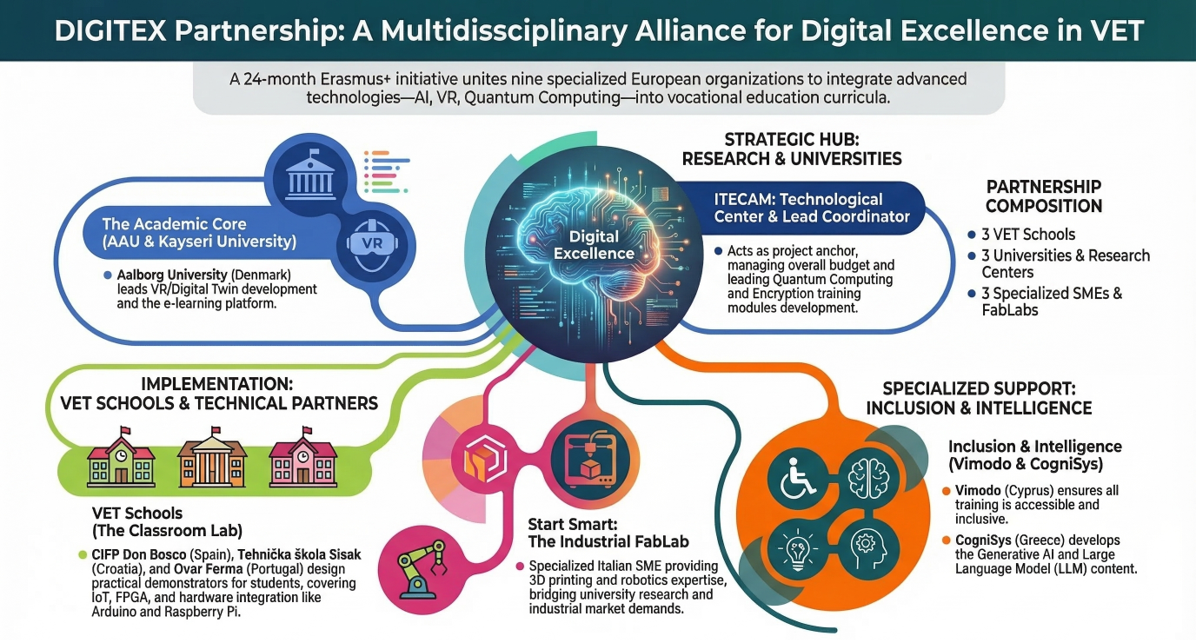
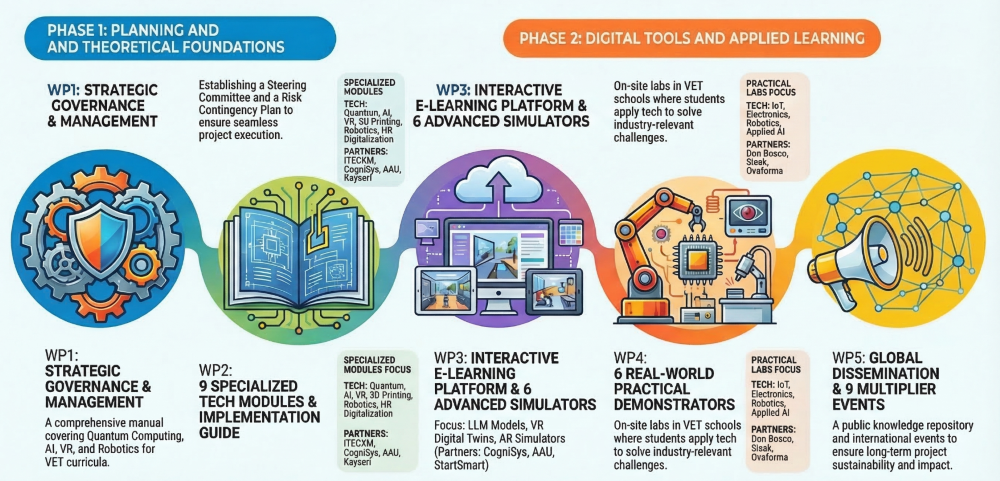
The DIGITEX project (Digital Transformation for Vocational Excellence: Innovating Education through Advanced Technologies) is an Erasmus+ Cooperation Partnership in vocational education and training (KA220-VET). Running for 24 months, the project aims to modernize vocational education by integrating advanced technologies, including artificial intelligence, IoT, cybersecurity, robotics, 3D printing, and quantum computing. To achieve these goals, the project is structured into five complementary Work Packages (WPs) with a total co-funded budget of 400,000.00 €. Each package is designed to sequentially build from theoretical frameworks to e-learning, practical classroom application, and European-wide dissemination.
- Lead Organisation: ITECAM (Spain).
- Core Technical & Administrative Actions:
- Governance & Steering: Establishment of a transnational Steering Committee composed of one representative from each partner organisation, meeting quarterly to assess progress and ensure quality standards.
- Operational Monitoring: Monthly virtual follow-up meetings via collaborative platforms (Microsoft Teams/Zoom) to coordinate day-to-day operations and resolve technical bottlenecks.
- Transnational Project Meetings (TPMs): Execution of seven planned meetings—with TPM0 and TPM5 held virtually, and TPM1 to TPM4 held in Spain, Italy, Denmark, and Spain respectively—to evaluate milestones, launch deliverables, and review digital platform developments.
- Strategic Planning: Drafting and implementing key strategic frameworks, including the Monitoring Plan (CogniSys), Risk Management Plan (ITECAM), Dissemination Plan (Vimodo), and Exploitation Plan (Kayseri University).
- Sustainability & Inclusivity: Incorporating “green practices” (such as prioritizing terrestrial transport for shorter distances and using virtual platforms to reduce emissions) and inclusive design (Universal Design for Learning – UDL) across all administrative levels.
- Lead Organisation: CogniSys (Greece).
- Core Technical Actions:
- Methodological Standardization: Establishing uniform content templates and educational guidelines during the TPM1 kick-off meeting in Spain to ensure standard curriculum development across the consortium.
- Development of 9 Specialized Learning Modules: Partners collaborate to write detailed theoretical modules on cutting-edge technologies:
- Quantum Computing & Encryption: Grounding concepts and simulator theories (ITECAM).
- Artificial Intelligence & Generative Models: Training, running, and installing LLMs (CogniSys).
- Digitalization in HR Management: Integrating digital tools into corporate human resources (Kayseri University).
- Digital Twins & Virtual Reality (VR): VR environment designs and templates for Oculus Quest devices (Aalborg University).
- 3D Printing & Robotics: Tinkercad modeling, rapid prototyping, and mechatronic design (StartSmart).
- Inclusive Strategies & Diverse Evaluation: Designing accessible assessments and support tools (Vimodo).
- VR Programming in Unreal & Unity: Development of interactive virtual templates (Sisak Technical School).
- 3D Modeling in Blender: Advanced texturing, animations, and model preparation (Sisak Technical School).
- FPGA Logic & Communication Protocols: Digital logic, MQTT, and industrial communication (CIFP Don Bosco). (Note: Ovar Forma also develops integration of microcontrollers with Node-RED, ESP32, and Raspberry Pi)
- Evaluation Tools: Vimodo designs custom rubrics to evaluate students with diverse learning profiles (such as ADHD, Asperger, and dyslexia).
- Core Deliverable: Assembly and validation of all content into a comprehensive “Manual and Implementation Guide” compiled by CogniSys.
- Lead Organisation: Aalborg University (Denmark).
- Core Technical Actions:
- E-learning Platform Development: Designing, hosting, and maintaining an advanced e-learning platform compatible across different devices and screen readers.
- Interactive Digitalization: Adapting the 9 theoretical modules into dynamic, interactive online courses featuring multimedia activities, quizzes, and automated scoring.
- Multilingual Accessibility: Translating the digital curriculum into 8 languages (English, Spanish, Portuguese, Greek, Italian, Danish, Turkish, and Croatian) to facilitate transnational use.
- Development of 6 Advanced Digital Tools: Integrating customized simulators and software directly into the platform:
- Quantum Computing Simulator (ITECAM).
- Generative AI Large Language Model (LLM) (CogniSys).
- VR Digital Twin Template (Aalborg University).
- HR Digital Transformation Platform (Kayseri University).
- Robotics Augmented Reality (AR) Simulator (StartSmart).
- Educational Diversity Support Tool (Vimodo).
- Usability Pilots: Running pilot tests with at least 5 users per partner to validate platform navigation, collect user feedback, and compile a technical evaluation report (analyzed by Kayseri University).
- Capacity Building: Coordinating the C1 Teacher Training activity in advanced robotics alongside TPM2 in Italy to prepare instructors to pilot these tools.
- Lead Organisation: StartSmart (Italy).
- Core Technical Actions:
- Creation of 6 Classroom Demonstrators: Implementing advanced use-cases (2 per VET school) to allow applied, hands-on learning:
- CIFP Don Bosco (Spain): Practical learning scenarios in robotics and quantum computing.
- Tehnička škola Sisak (Croatia): Immersive learning use-cases using Virtual Reality and Digital Twins.
- Ovar Forma (Portugal): Active training setups with 3D printing, connected sensors, and generative LLMs.
- PBL & Design Thinking: Guiding students to solve real-world industrial or community digital transformation challenges through cooperative projects.
- Diverse Inclusivity Adaptation: Adapting all physical and simulator-based activities using Universal Design for Learning (UDL) to make sure students with special educational needs participate fully.
- Job Shadowing Mobilities (C2, C3, and C4): Organizing three teacher-exchange training events in Portugal, Croatia, and Spain to observe classroom implementations, share hardware configurations, and validate the use-cases.
- Consolidation: Peer-reviewing and optimizing the demonstrators (led by Aalborg and CogniSys) before finalizing the WP4 phase.
- Creation of 6 Classroom Demonstrators: Implementing advanced use-cases (2 per VET school) to allow applied, hands-on learning:
- Lead Organisation: Co-managed by Vimodo (Dissemination) and Kayseri University (Exploitation).
- Core Informational & Dissemination Actions:
- Dissemination Campaign: Organizing social media dissemination (aiming for 50+ posts and 500+ followers), publishing 4 educational newsletters, and coordinating at least 18 specialized media articles/press releases (2 per partner).
- Open-Access Portal: Constructing and updating the project website (Aalborg University) to serve as a public repository for all manuals, e-learning courses, and software tool downloads.
- Exploitation & Sostenibilidad: Setting up formal agreements between educational centers, industrial companies, and public institutions to embed the DIGITEX curriculum into regular, long-term training programs.
- 9 Transnational Multiplier Events: Conducting local multiplier events in each partner country (with over 20 guests per event) and a large-scale final conference in Spain organized by ITECAM (aiming for 50+ attendees) to demonstrate results directly to vocational education managers, teachers, and regional business leaders.
- Long-Term Access: Ensuring the web portal and platform remain fully active and updated for a minimum of 5 years following project completion.

Co-funded by the Erasmus+ Programme of the European Union. DIGITEX project (“Digital Transformation for Vocational Excellence: Innovating Education through Advanced Technologies”) is funded with support from the European Commission. This website reflects the views only of the authors, and the Commission or National Agencies cannot be held responsible for any use which may be made of the information contained therein.
Copyright 2026 – ITECAM – DIGITEX ERASMUS+ PROJECT Powered by Spexo Wordpress Theme