

Results
The DIGITEX project (Digital Transformation for Vocational Excellence: Innovating Education through Advanced Technologies) is committed to delivering concrete, open-access resources to modernize vocational education and training (VET) across Europe. By bridging the gap between education and industrial labor market demands, our transnational partnership is generating high-value digital assets, practical educational methodologies, and inclusive tools.
Explore the main tangible outcomes and deliverables of our project:
1. The DIGITEX Interactive E-Learning Platform
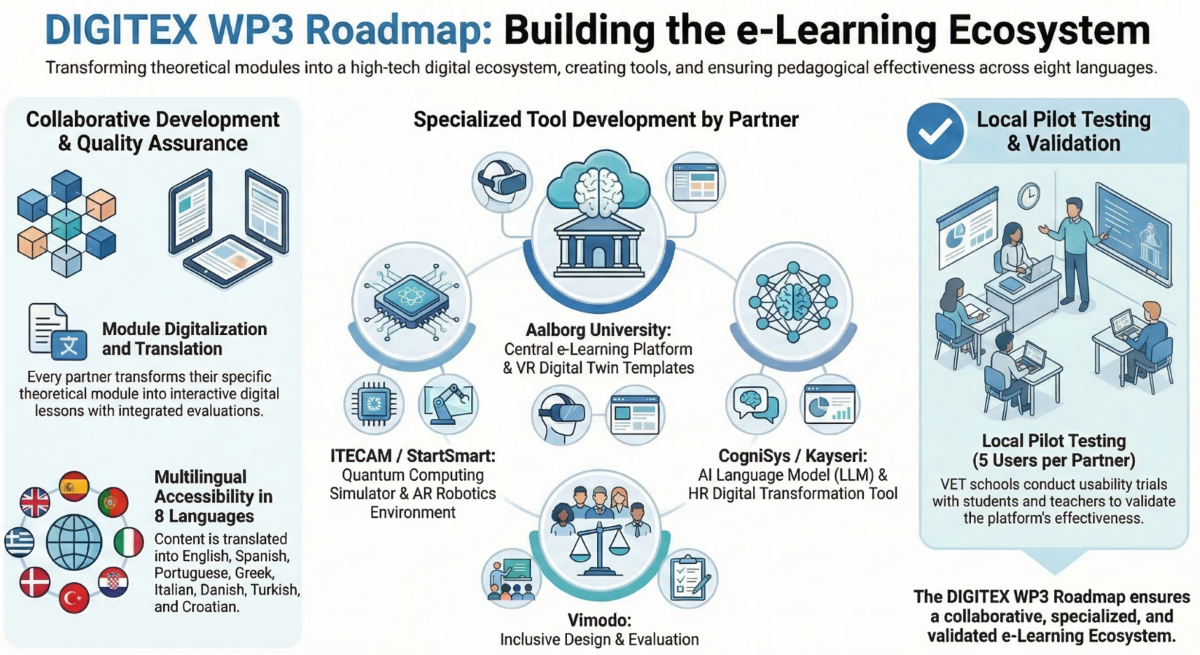
At the core of our technical deliverables is a state-of-the-art e-learning platform developed by Aalborg University. Designed to be fully accessible, responsive, and compatible with diverse screen readers, this platform serves as the central hub for our entire digital curriculum.
- Multilingual Access: All learning materials and interactive courses are translated and available in 8 languages: English, Spanish, Portuguese, Greek, Italian, Danish, Turkish, and Croatian.
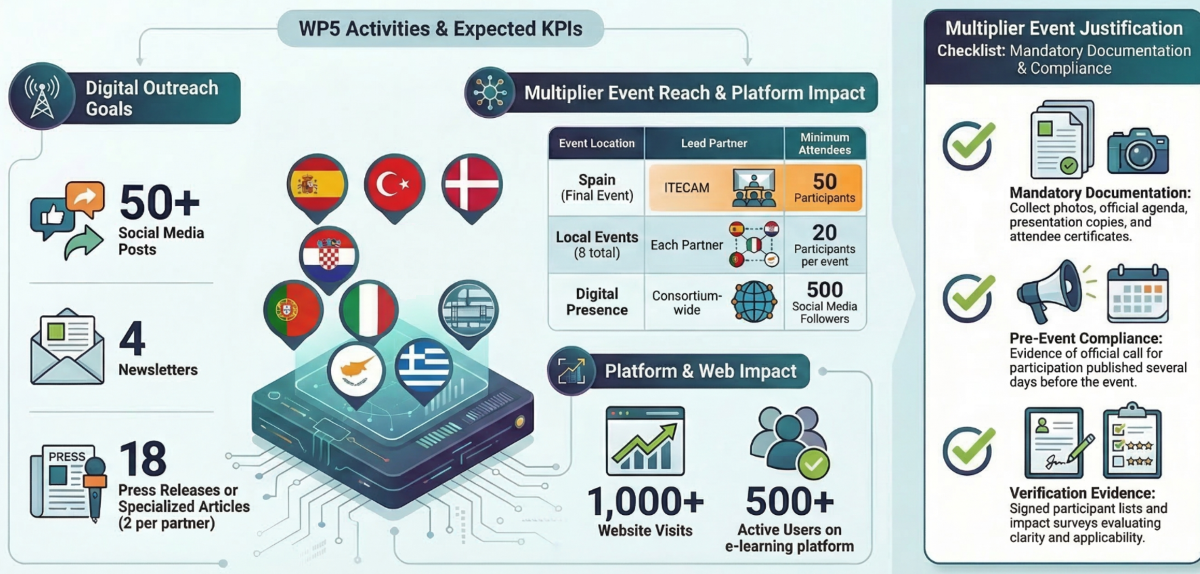
- Target Impact: We aim to reach at least 500 active registered users on the platform during the project’s lifespan.
2. 9 Specialized Digital Learning Modules
We have developed a comprehensive framework consisting of 9 theoretical and interactive modules aimed at equipping teachers and students with digital competencies in advanced technologies:
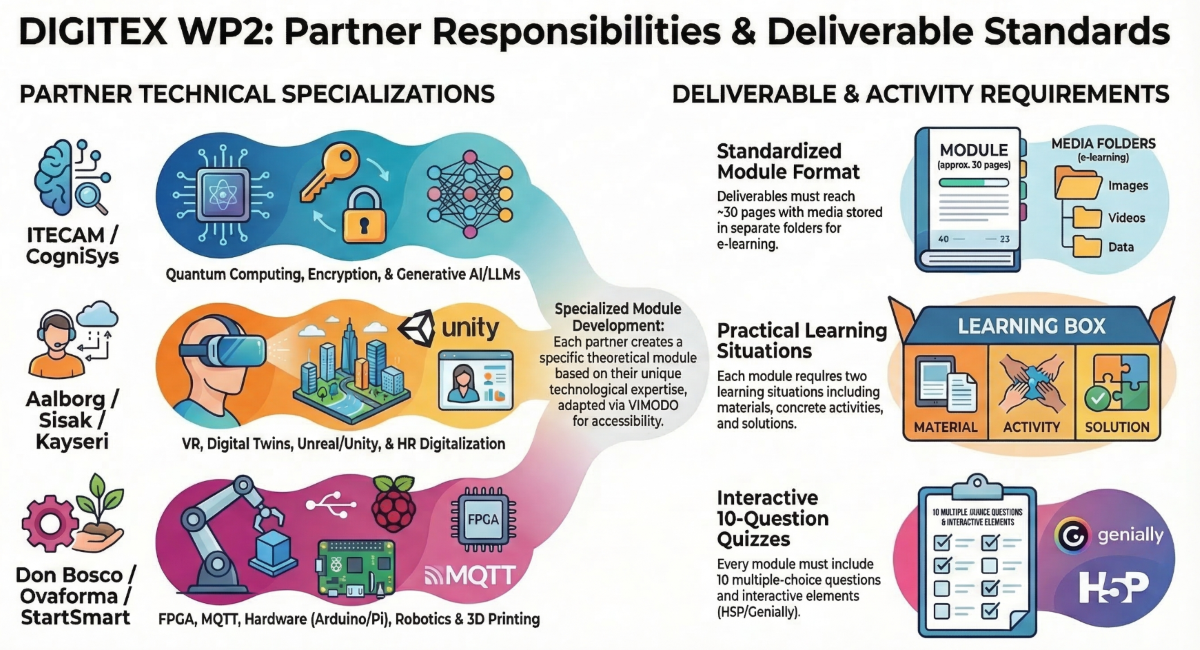
- Quantum Computing & Encryption – Conceptual foundations, cryptography, and simulators.
- Artificial Intelligence & Generative Models – Installing, training, and running Large Language Models (LLMs).
- Digitalization in HR Management – Preparing students and VET institutions for digital human resources systems.
- Digital Twins & Virtual Reality – 3D simulations and adaptive VR environments.
- 3D Printing & Robotics – Mechatronics, rapid prototyping, and CAD modeling.
- Inclusive Strategies & Diverse Evaluation – Specialized methodologies for neurodiverse learners.
- VR Programming in Unreal & Unity – Interactive programming and virtual template design.
- 3D Modeling in Blender – Advanced texturing, animations, and model preparation.
- FPGA Logic & Communication Protocols – Digital logic, industrial protocols, and MQTT.
3. 6 Advanced Digital Tools & Simulators
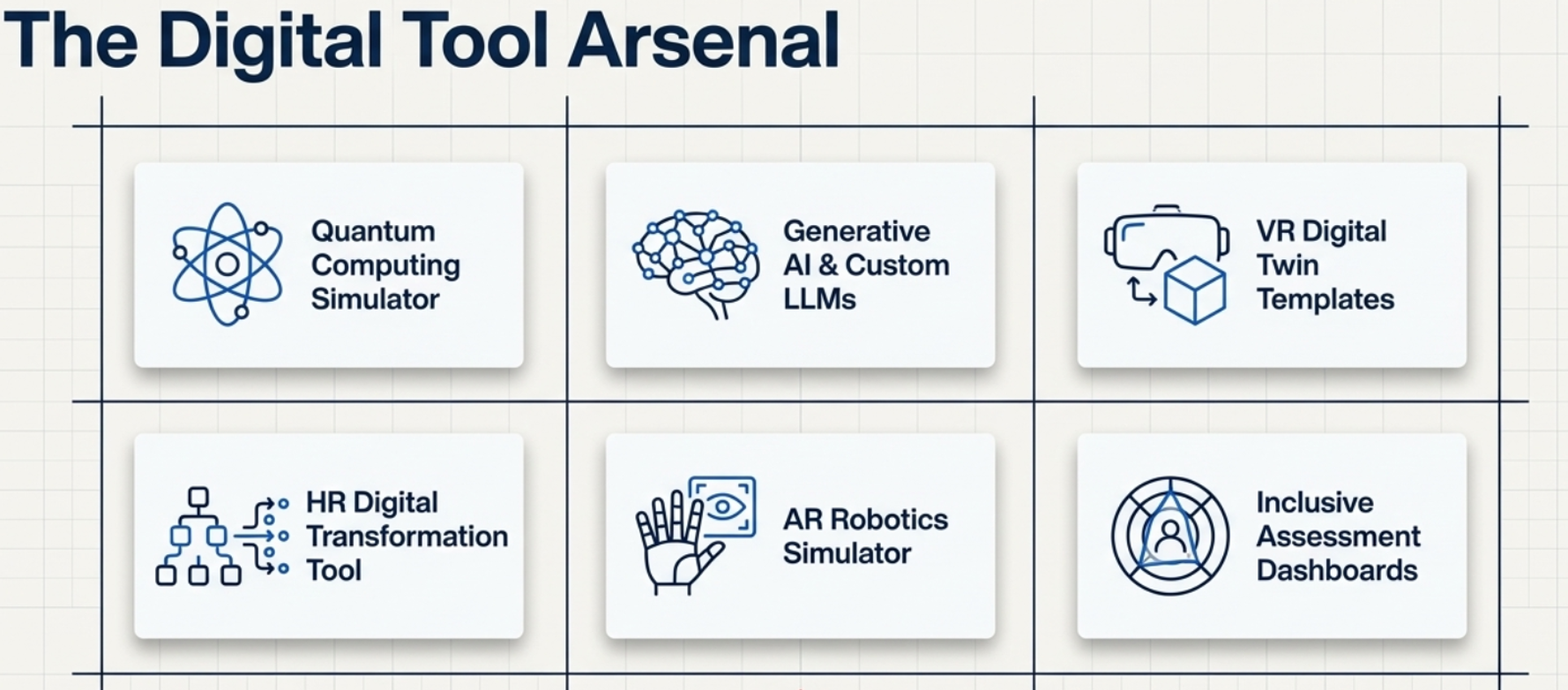
To complement theoretical knowledge with active, hands-on experimentation, DIGITEX integrates six customized digital tools directly into our online platform:
- Quantum Computing Simulator (Developed by ITECAM).
- Generative AI Large Language Model (LLM) (Developed by CogniSys).
- VR Digital Twin Template (Developed by Aalborg University).
- HR Digital Transformation Platform (Developed by Kayseri University).
- Robotics Augmented Reality (AR) Simulator (Developed by StartSmart).
- Educational Diversity Support Tool (Developed by Vimodo).
4. 6 Practical Classroom Demonstrators (Use Cases)
To ensure our digital resources are effectively applied in real educational settings, the consortium’s VET schools are implementing six physical demonstrators (2 per school):
- CIFP Don Bosco (Spain): Applied use cases in robotics and quantum computing.
- Tehnička škola Sisak (Croatia): Immersive setups using VR environments and digital twins.
- Ovar Forma (Portugal): Physical-digital integration utilizing 3D printing, connected sensors (IoT), and generative LLMs.
These demonstrators employ Project-Based Learning (PBL) and Design Thinking, guiding students to solve real-world industrial or community digital challenges.
5. Replicable Resources & Policy Impact Guides
To guarantee long-term sustainability and European-wide transferability, the project is publishing several key documentation packages:
- The DIGITEX Manual & Implementation Guide: A consolidated reference document compiled by CogniSys, which gathers all 9 theoretical modules, best practices, and pedagogical frameworks for educators across Europe.
- Universal Design for Learning (UDL) Rubrics: Specialized evaluation systems designed by Vimodo, providing educators with concrete frameworks to adapt technical teaching to students with diverse learning profiles, including ADHD, Asperger’s, and dyslexia.
- Plan of Exploitation: Led by Kayseri University, this strategic plan outlines agreements with regional industrial partners and VET authorities to embed the DIGITEX digital curriculum into national educational programs

Co-funded by the Erasmus+ Programme of the European Union. DIGITEX project (“Digital Transformation for Vocational Excellence: Innovating Education through Advanced Technologies”) is funded with support from the European Commission. This website reflects the views only of the authors, and the Commission or National Agencies cannot be held responsible for any use which may be made of the information contained therein.
Copyright 2026 – ITECAM – DIGITEX ERASMUS+ PROJECT Powered by Spexo Wordpress Theme